Sunday, 5 April 2020

How I Drove 231,608 Visitors to My Site Using Push Notifications

Just like any marketer, we all fear what we can’t control.

And sadly, for years, a lot of our future is being determined by algorithms.

From social sites to search engines… they all have algorithms. Heck, you even have to deal with them with things like email.

When you send marketing emails, you can bet that there is a good chance that they will end up in the “Promotions tab.”

Now sometimes these algorithms do adjust in your favor, but we all know that’s rare in the long run.

But what if there was a way you could drive consistent traffic, not have to deal with algorithms, and not have to spend money on ads?

There actually is. And I bet you’ve never used it before.

Here’s the best part, it’s generated me more than 231,608 visitors and it automated and free. 🙂

How so?

Alright, check this out.

Every time I publish a blog post or anytime I want to drive traffic to any page on my site, all I have to do is click a few buttons and instantly I am able to get more traffic.
So how do I do this?

It’s with a free tool I built called Subscribers.

It leverages something that you are familiar with but probably don’t know what it is.

It’s called push notifications.

What’s a push notification?

Does this look familiar to you?
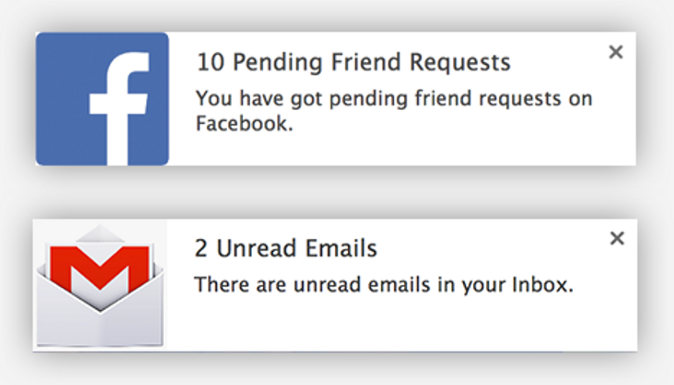
You can receive messages through your browsers. This is called a push notification.

What’s cool about push notifications is that anytime someone visits your website you can ask them to subscribe to your site.
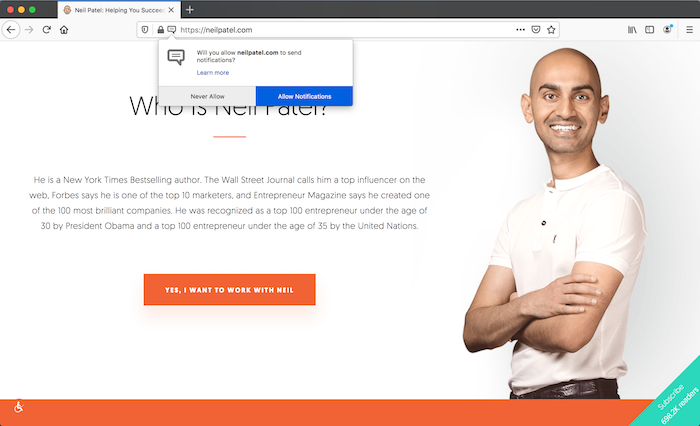
And at any time, you can send them a message promoting your website.
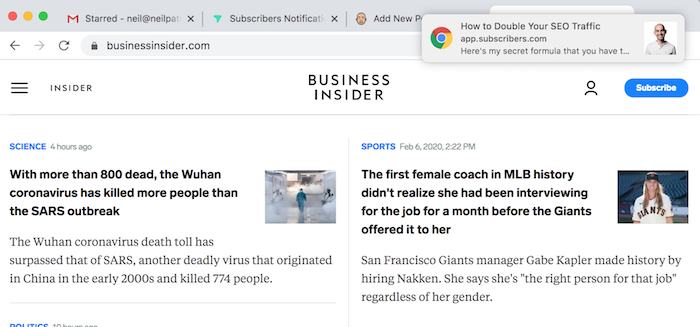
Each time someone clicks on it, you get traffic to your site.

But here is the best part: not only do you not have to deal with any algorithms, but you also don’t have to worry about people missing your push notification either.

See, unlike email, if you send someone a push notification while they are on vacation or sleeping, the next time they log onto their computer and pull up their web browser (Chrome, Safari, Firefox), they’ll see the push notification.

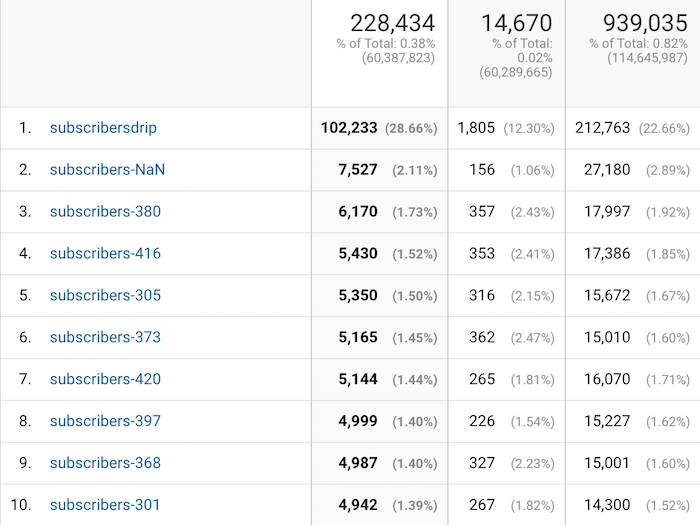
Here are my stats from some of my most recent push notifications:
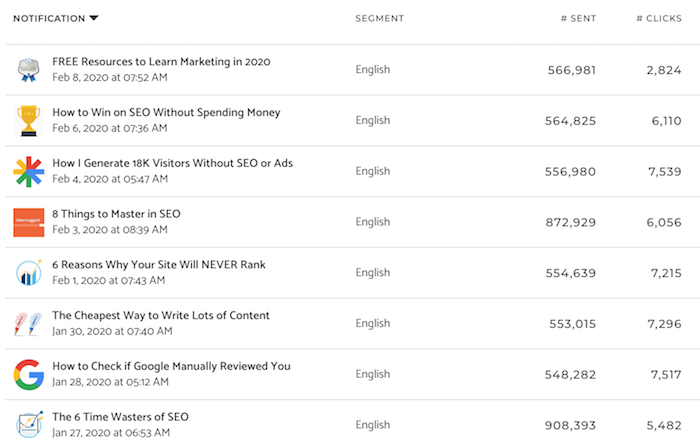
How to grow your traffic through push notifications

Head over to Subscribers and sign up for a free account.

Once you add your site and sign up, you’ll need to either add a piece of javascript to your site or you’ll have to install a plugin.

Whether you are on Shopify or WordPress, Subscribers has a good amount of options for you.

Once you are up and running, you’ll want to head to the “prompt settings” navigation option in the sidebar of Subscribers.
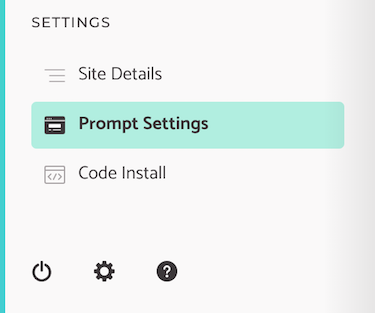
This is where you control what people see when they come to your website so they can subscribe.

You’ll want to make sure you have turned on “prompt enabled.” Then select “use custom popup prompt by default” as this will allow you to select what message you show your users.

Here’s what my page looks like.
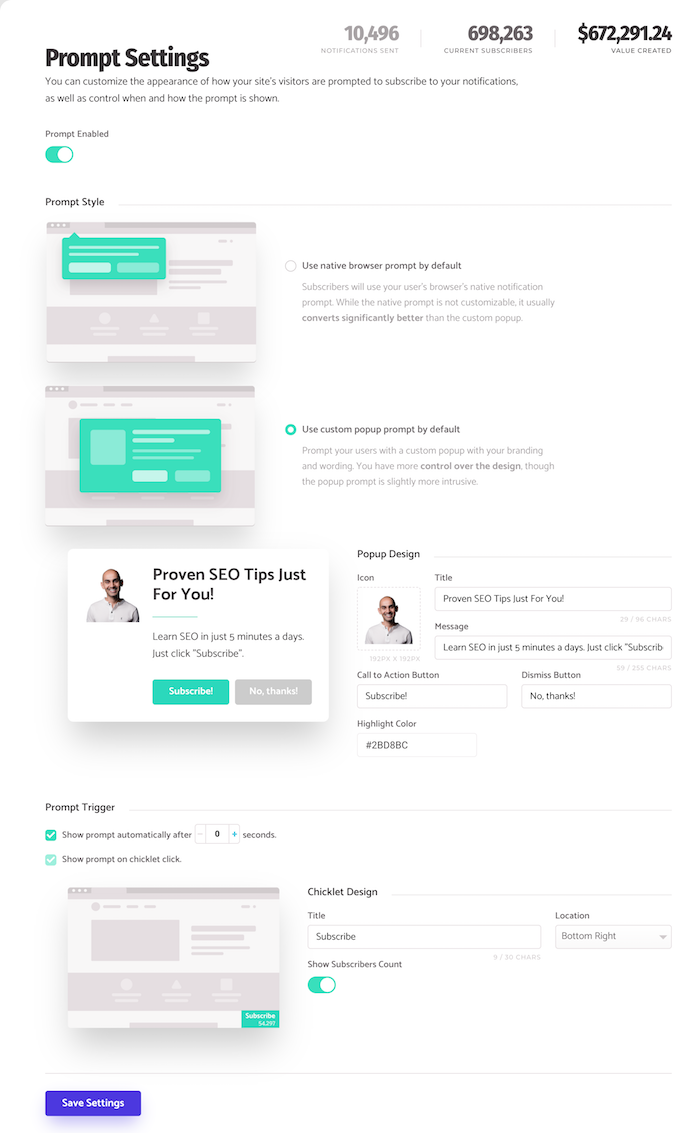
In my prompt settings, you’ll notice I did a few things:

  1. I uploaded my own image. My site is NeilPatel.com so it makes sense for me to use my own image. For you, it could be your face or your company logo.
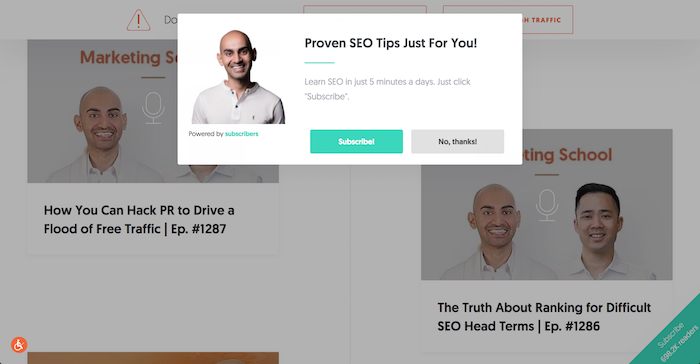
  2. For the title and description, you’ll want to clearly state the benefit. I let you know that I am going to send you proven SEO tips and how easy it will be.
  3. You can then test the “subscribe” and “no thanks” button text. I’ve found that text to work well on my site.
  4. As for timing, I like showing the prompt right away as well as showcasing my “subscriber count.” I’ve found that the bottom-right corner converts well for me.

Once everything is set up the way you want, just click “save settings” and you’ll see your prompt on your site.

Here’s what it looks like on the NeilPatel.com site.
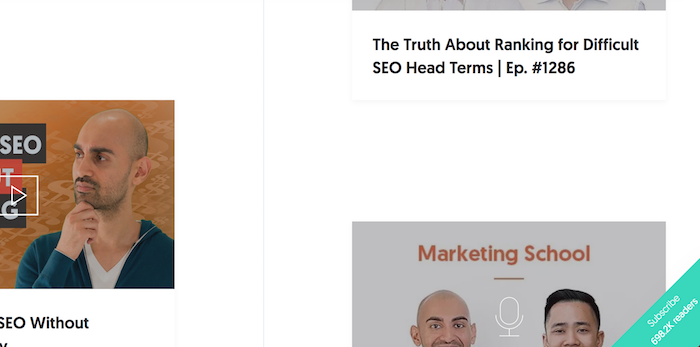
When someone clicks on “subscribe” they will see a prompt box that looks something like this…
And then when they click to subscribe in the prompt box their browser will ask them if they want to subscribe to your site.

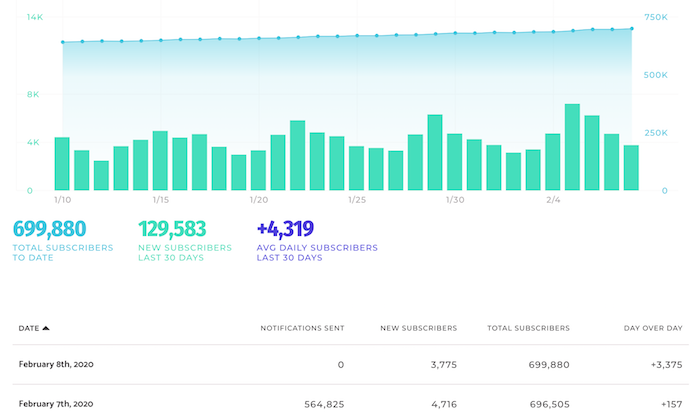
It’s so effective I have over 600,000 subscribers. It’s a lot!

It may take time for your subscriber numbers to build up, but the longer you do it the easier it is. Keep in mind I’ve been doing this for a few years now, that’s how I have been able to build up such a large following.

So, once you have subscribers, what’s next?

How to generate traffic through subscribers

What I like doing is promoting my blog posts through Subscribers.

Just click on the “New Notifications” navigation link.
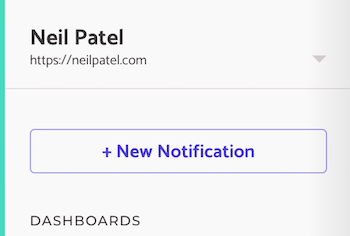
You’ll now be able to send a message to all of your subscribers. More importantly, you’ll be able to promote a URL or a service or product you are selling.
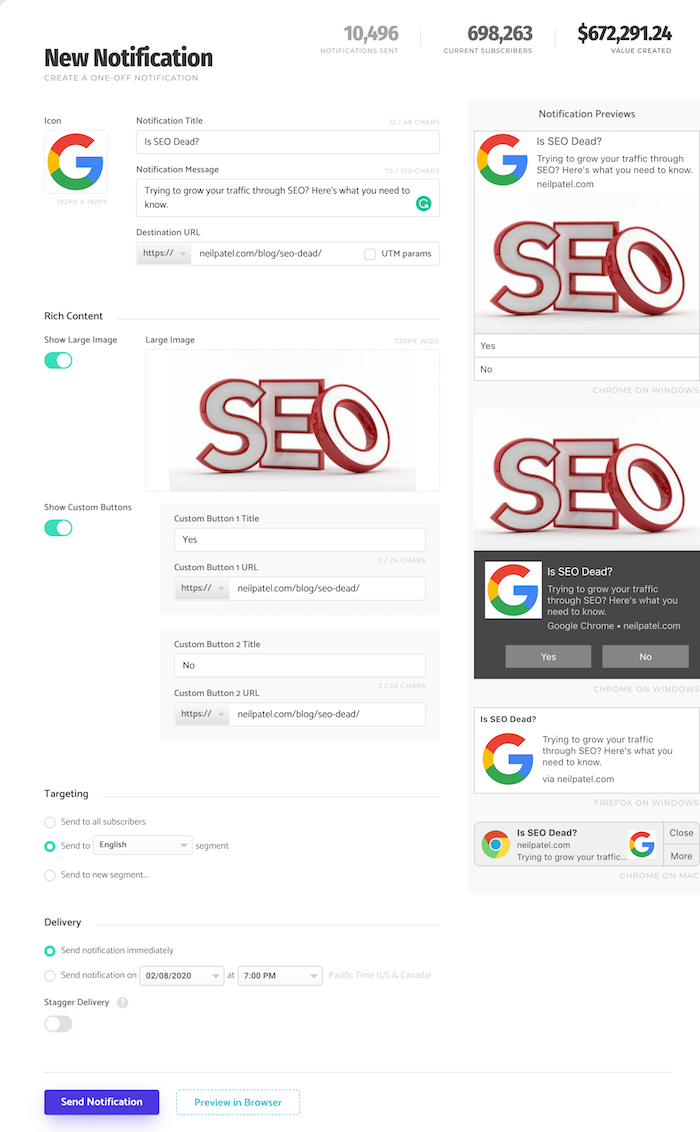
There are a few key things you’ll want to do on this page if you want the maximum amount of traffic.

  1. Evoke curiosity – with your headline and description try to pique peoples’ curiosity. This is a simple way to get a ton of clicks. Just like how I asked, “Is SEO Dead?”
  2. Show a large image – when you use a large image, you’ll find that you will get more clicks. Large images don’t show up on all push notifications, it only shows up for users who are on a PC. If you don’t know where to find images, you can use this free stock photography site.
  3. Show custom buttons – this feature also only shows up on PCs and not Macs. But it is still worth using. I’ve found that if I can ask a “yes or no” type of question with my headline, such as “Is SEO Dead?” then when I use “yes” and “no” as the two options in the custom buttons, I get a ton of clicks.

If you follow those 3 tips, you’ll find that you’ll be able to maximize how much traffic you get from push notifications.

Just look at the push I did on the post about SEO being dead… it drove 16,263 visitors to my blog. That’s a lot of traffic for one push notification.

Don’t forget to set up a Welcome Campaign

Now the best way to generate traffic from Subscribers isn’t to manually send out notifications.

Yes, manual notifications generate traffic but there is a better way.

Through a Welcome Campaign, you can generate even more traffic.

Think of a “welcome campaign” as a drip sequence like you would have in email. But this is through push notifications.

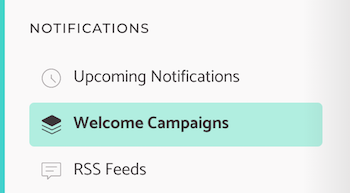
So, in the navigation click on “Welcome Campaign.”
From there, you’ll want to click on “create a new campaign.” From there you will see a page that looks like this:

Similar to sending a normal push notification, you’ll want to use a larger image and use custom buttons as this increases how many clicks you’ll get to your site.

The other thing you’ll want to do is be careful and not spam. Don’t send them a message every 30 minutes or anything annoying like that. I spread out my messages in my drip by at least a few days.

The first notification goes out instantly, but the rest are spread out.

Once you set up your welcome campaign, just hit save and you’ll be good to go.

As new people subscribe to your site, they will automatically receive notifications which will increase your traffic.

Just like at my welcome campaign stats, it drives more traffic than manual pushes.
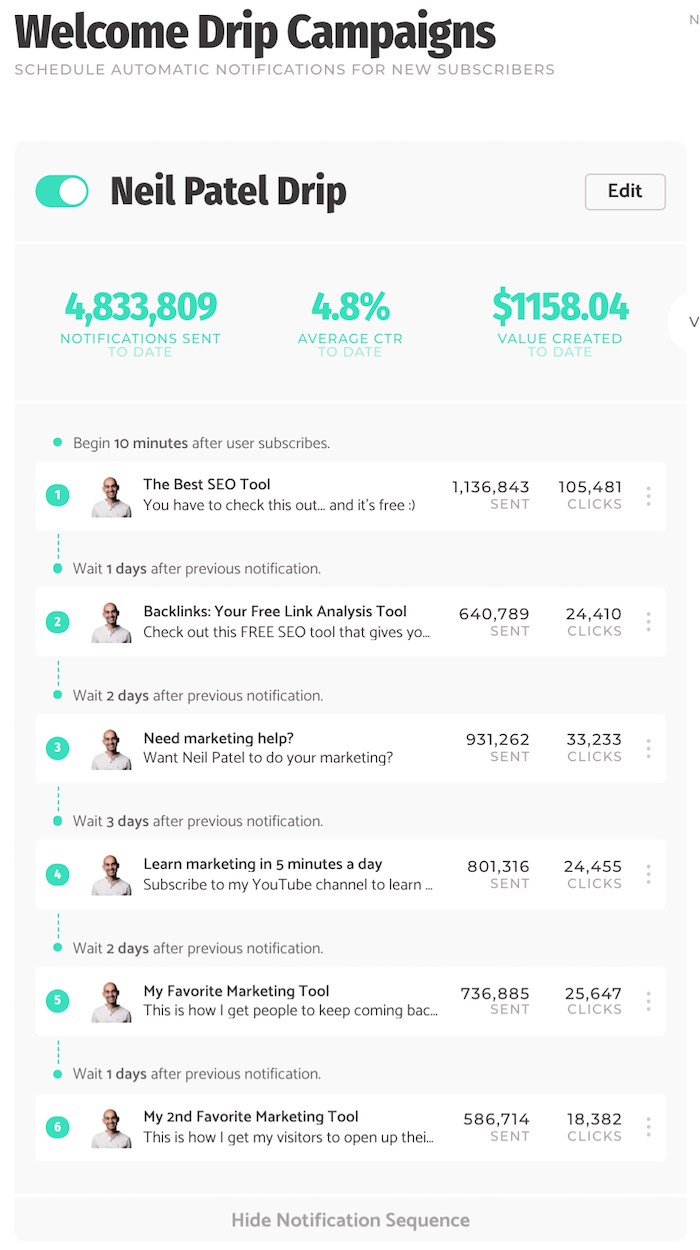
231,608!

That’s how much traffic I’ve gotten just from my welcome campaign and that number continually climbs each day.

Conclusion

Although most of the popular platforms have algorithms that are hard to crack, it doesn’t mean that all hope is lost.

There are still other ways to get consistent traffic to your site.

What’s beautiful about Subscribers is that it drives traffic without you having to deal with algorithms or filters. But it does take time to see results, just like email marketing, the longer you use it the more traffic you’ll see.

So, have you tried push notifications or Subscribers before?

The post How I Drove 231,608 Visitors to My Site Using Push Notifications appeared first on Neil Patel.


* This article was originally published here

Friday, 3 April 2020

Marketing in Times of Uncertainty - Whiteboard Friday

Posted by randfish

Our work as marketers has transformed drastically in the space of a month. Today, we're grateful to welcome our good friend Rand to talk about a topic that's been on the forefront of our minds lately: how to do our jobs empathetically and effectively through one of the most difficult trials in modern memory.

We hope you've got a cozy seat in your home office, a hot mug of coffee from your own kitchen Keurig, and your cat in your lap as you join us for this week's episode of Whiteboard Friday.

Video Transcription

Howdy, folks. I'm Rand Fishkin, founder of Moz and co-founder of Sparktoro. And I'm here today with a very special edition of Whiteboard Friday. 

I think that now is the right time to talk about marketing in uncertain epochs like the one we're living through. We obviously have a global crisis. It's very serious. But most of you watch Whiteboard Friday. Know that here at Moz, right, they're trying to help. They want to help people through this crisis. And that means doing marketing. And I don't think that now is the right time for us to stop our marketing activities. In fact, I think it's time to probably crunch down and do some hard work. 

So let's talk about what's going on. And then I'll give some tactics that I hope will be helpful to you and your teams, your clients, your bosses, everyone at your organizations as we're going through this together. 

The business world is experiencing widespread repercussions

First off, we are in this cycle of trying to prevent massive amounts of death, which is absolutely the right thing to do. But because of that, I think a lot of us in the business world, in the marketing world, are experiencing pain, particularly in certain industries. In some industries obviously demand is spiking, it's skyrocketing for, you know, coronavirus-related reasons. And in other cases, demand is down. That's because we sort of have this inability to go out.

We can't go to bars and restaurants and movies and bowling alleys and go do all the things we would normally do. So we don't need fancy clothes to go do it and we don't need haircuts — this is probably the last Whiteboard Friday I would want to record before needing a cut. And all of that spending, right, that consumer spending affects business-to-business spending as well

Lower spending → cost-cutting → lower investment/layoffs → environment of fear...

It leads to cost cutting by businesses because they know there's not as much demand. It leads to lower investment and oftentimes layoffs as we saw in the United States, where nearly 10 million workers are are out of work, according to the latest stats from the federal government. And that builds this environment of fear, right. None of us have faced anything like this. This is much bigger and worse, at least this spike of it is, than the Great Recession of 2008. And, of course, all of these things contribute to lower spending across the board. 

However, what's interesting about this moment in time is that it is a compressed moment. Right. It's not a long-term fear of of what will happen. I think there's fears about whether the recession will take a long time to recover from. But we know that eventually, sometime between 3 and 18 months from now, spending will resume and there will be this new normal. I think of now as a time when marketing needs to change its tone and attitude.

Businesses need to change their tone and attitude and in three ways. And that's what I want to talk through. 

Three crucial points

1. Cut with a scalpel, not with a chainsaw

First off, as you are looking to save money and if you're an agency, if you're a consultant, your clients are almost certainly saying, "Hey, where can we pull back and still get returns on investment?" And I think one of the important points is not to cut with a chainsaw. Right. Not to take a big whack to, "Oh, let's just look at all of our Google and Facebook ad spending and cut it out entirely." Or "Let's look at all of our content marketing investments and drop them completely." That's not probably not the right way to go. 

Instead, we should be looking to cut with a scalpel, and that means examining each channel and the individual contributors inside channels as individuals and looking at whether they are ROI-positive. I would urge against looking at a say, one-week, two-week, three-week trend. The last three weeks spending is very frozen and I believe that it will open up more again. I think most economists agree. You can see that's why the the public stock markets have not crashed nearly as hard. We've had some bouncing around.

And I think that's because people know that we will get to this point where people are ordering online. They are using businesses online. They are getting deliveries. They are doing activities through the Internet over the course of however long we're quarantined or there is fear about going out and then it will return to a new normal. 

And so because of that, you should probably be looking something like six to twelve weeks in the past and trying to sort out, OK, where are the trends, where are their lifelines and opportunities and points of light? And let's look at those ROI-positive channels and not cut them too soon. 

Likewise, you can look inside a channel. If you haven't seen it already, I highly recommend Seer Interactive's guide to cutting with a scalpel, not a sledgehammer, and they look at how you can analyze your Google Ads accounts to find keywords that are probably still sending you valuable traffic that you should not pull back on. I would also caution — I've talked to a bunch of folks recently who's seen Facebook and Instagram and Twitter and YouTube and Google ad inventory at historically low prices. So if you have ROI-positive channels right now or your clients do, now is an awesome time to be to potentially be putting some dollars into that. 

2. Invest now for the second & third waves in the future

Second thing, I would invest now for the second and third waves. I think that's a really smart way to go. You can look at Harvard Business Review and Bloomberg and a bunch of folks have written about investing during times of recession, times of fear, and seeing how. Basically when we when we go through wave one, which I think will be still another two to six weeks, of sort of nothing but virus-related news, nothing but COVID-19, and get to a point where we're transitioning to this life online. It's becoming our new every day. And then getting to a post-crisis new normal, you know, after we have robust testing and quarantining has hopefully worked out well. The hospital systems aren't overwhelmed and maybe a vaccine as is near development or done.

When those things start to come, we will want to have now messaging and content and keyword demands serving. Right. And ads and webinars. Anything that is in our marketing inventory that can be helpful to people, not just during this time, but over the course of these, because if we make these investments now, we will be better set up than our competitors who are pulling back to execute on this. And that is what that research shows, right, that essentially folks who invest in marketing, in sales during a recession tend to outperform and more quickly outperform their competition as markets resume. You don't even have to wait for them to get good — just as they start to pick up. 

3. Read the room

The third and possibly most important thing right now is, I think, to read the room. People are paying attention online like never before. And if you're doing web marketing, they're paying attention to your work. To our work. That means we need to be more empathetic than we have been historically, right? They are. Our audiences are not thinking about the same things they were weeks ago. They're in a very new mindset. It doesn't matter if they're business-to-business or business-to-consumer. You are dealing with everyone on the planet basically obsessed with the conditions that we're all in right now. That means assuming that everyone is thinking about this.


I really think the best type of content you create, the best type of marketing you can create right now across any channel, any platform is stuff that helps first. Helps other people. It could be in big ways. It could be in small ways. 

The Getty Museum, I don't know if you saw Avinash Kaushik's great post about the Getty Museum. They did this fun thing where they took pictures from their museum, famous paintings and they put them online and said, "Hey, go around your home and try and recreate these and we'll post them." Is it helping health care workers get masks? No. But is it helping people at home with their kids, with their families, with their loved ones have a little fun, take their mind off the crisis, engage with art in a way that maybe they can't because they can't go to museums right now? Yeah, that's awesome. That's fine. It's okay to help in little ways, too, but help first. 

I also think it's okay to talk about content or subjects that are not necessarily related to the virus. Look, web marketing right now is not directly related to the coronavirus. It's not even directly related to some of the follow-on effects of that. But I'm hoping that it's helpful. And I'm hoping that we can talk about it in empathetic and thoughtful ways. We'd just have to have to read the room. 

It is okay to recognize that this crisis is affecting your customers and to talk about things that aren't directly related but are still useful to them. 

And if you can, I would try not to ignore this, right? Not not to create things that are completely unrelated, that feel like, "Gosh, this could have been launched at any time in the last six months, sort of feels tone deaf." I think everything that we do is viewed through the lens of what's happening right now. And certainly I have that experience as I go through online content. 

Do not dismiss the scenario. I think that that history will reflect very poorly. History is moving so fast right now that it is already reflecting poorly on people who are doing this. 

Don't exploit the crisis in a shameless way. I've seen a few marketing companies and agencies. I won't point them out because I don't think shaming is the right thing to do right now, but show how you're helping. Don't exploit by saying "It's coronavirus times. We have a sale." All right? Say, "Oh, we are offering a discount on our products because we know that money is tight right now and we are helping this crisis by donating 10 percent of whatever." Or, "We are helping by offering you something that you can do at home with your family or something that will help you with remote work or something that will help you through whatever you're going through," whatever your customers are going through. 

Don't keep your tone and tactics the same right now. Oh, yes, I think that's kind of madness as well. I would urge you, as you're creating all this potentially good stuff, new stuff, stuff that plans for the future and that speaks to right now, go ahead and audit your marketing. Look at the e-mail newsletters you're sending out. Look at the sequential emails that are in your site onboarding cycles. Look at the overlay messaging, look at your home page, look at your About page

Make sure that you're either not ignoring the crisis or speaking effectively to it. Right. I don't think every page on a website needs to change right now. I don't think every marketing message has to change. But I think that in many cases it's the right thing to do to conduct an audit and to make sure that you are not being insensitive or perceived as insincere. 

All right, everyone, I hope that you are staying safe, that you're staying at home, that you're washing your hands. And I promise you, together, we're going to get through this.

Thanks. Take care.

Video transcription by Speechpad.com


Sign up for The Moz Top 10, a semimonthly mailer updating you on the top ten hottest pieces of SEO news, tips, and rad links uncovered by the Moz team. Think of it as your exclusive digest of stuff you don't have time to hunt down but want to read!


* This article was originally published here

Wednesday, 1 April 2020

What Readers Want During COVID-19: Content Ideas for Every Niche

Posted by amandamilligan

This is a stressful time to say the least. Everything is impacted by COVID-19 in some way, including our work.

Once we’ve taken time to acknowledge how lucky we are to work in digital, it’s time to assess if our current content strategy needs any adjusting based on current events.

Many marketers are finding themselves:

  • Wanting to write about something topical
  • Needing to add more content to their calendars
  • At a loss for how to contribute at a time like this

So, I spent hours using Ubersuggest, putting myself in the shoes of various Americans. I tested a variety of keywords to see which ones have exhibited a trend during the COVID-19 outbreak and might warrant some attention from content marketers.

The results below are for the term “Coronavirus,” so for the other keywords identified, I looked for a noticeable spike in the months of January, February, and March to make sure they matched up accordingly.

My findings reveal potential topic ideas for several primary industries. See if any provide inspiration for high-quality content you can create in the coming months.

    Travel

    I’ll start with one of the industries hardest hit by this pandemic: travel. This was a tough one, as more and more people are understandably opting for driving, walking, or biking to get around, and are no longer relying on air travel or public transportation as trips and work get cancelled. However, I identified a few key opportunities.

    Travel insurance

    While it had an increase in the summer months, interest in the topic of travel insurance has risen back up again. Perhaps those who have to travel want to make sure they’re covered if they get sick, or maybe those who canceled travel want to see what their insurance covers.

    In either case, people are looking for information about travel insurance and how it can help them.

    Train travel

    It seems that train travel falls into an ambiguous category that people are asking about. I’m not here to say whether it’s safe or not (as that is obviously not my area of expertise). As we’ve all heard, it’s best not to travel at all, but perhaps your brand can offer some clarity in this regard and offer alternatives.

    Virtual travel

    For everyone stuck at home but still grappling with wanderlust, how can they still explore from the couch? Virtual travel seems to be gaining popularity as more people find themselves stuck at home.

    Work and education

    In some cases, companies and schools have gone from in-person to virtual nearly overnight. It’s been a huge shakeup across the board, and relevant topics are trending accordingly.

    Homeschooling

    Many kids are home from school, and their parents are suddenly and unexpectedly in the position of teaching them. They’re sure to have a lot of questions! Note how the search level now is the same as the summer months, when kids are also home.

    Free online courses

    With all plans essentially cancelled as a result of “social distancing,” people are looking for ways to spend their time at home. If you offer online courses, consider amplifying them and explaining their value. If you don’t, consider whether it makes sense to create one.

    Working from home tips

    Executives and staff alike are looking for advice on how to improve productivity while working from home, perhaps for the first time. Consider creating content with suggestions on how to set up a home office or maintain a schedule while dealing with at-home distractions.

    How to stay focused

    Whether it’s because people are working or studying at home for the first time or because they’re anxious and distracted by the developing events, more and more people are struggling to stay focused. Can your brand offer anything by way of motivation or tools for focus and efficiency?

    Entertainment

    Everyone’s at home either trying to distract themselves from the stressful reality of the world or looking to cure their boredom. As a result, online entertainment is on the rise. Can you offer the entertainment itself, or maybe guides on how to choose the best entertainment?

    Free streaming

    We’re stuck with digital for now, and people are looking for new media to consume. What can your brand provide? Also trending: “cheap digital games” and “best multiplayer video games”.

    Learn to play piano online

    Some folks are using their newfound free time to work on hobbies and skills they haven’t had the chance to pursue in the past. Can your brand teach them anything?

    Best online shopping deals

    This is particularly interesting to me. Keyword rates for this term are as high as they were over the holidays. I’m wondering if people who still have disposable income will pass the time online shopping, while others who are more financially impacted will cut back, leaving things at a net equal?

    Finance

    Aside from the health and safety of the population, finance cuts most to the emotional core of this pandemic. Many people are laid off or can’t work, and financial worry is skyrocketing. What can you do to provide guidance or relief?

    Unemployment

    Many people are unexpectedly looking to file unemployment, and plenty of those people have no idea how to do it, how much money they’ll get, or how to get that information. Informative guides and tips could be hugely helpful in this area.

    Budgeting tips

    With layoffs and pay cuts, people are scrambling to find new ways to save money. Also trending with the same graph results: “How to invest money wisely” -- most likely because of the fluctuating stock market. Can you provide insight?

    Relationships

    When tensions run high, it’s important to pay attention to all the relationships in your life, meaning several subtopics in this vertical can be of vital importance.

    At home date ideas

    Couples stuck inside are looking for ways to keep up their romantic lives. Does it make sense for your brand to provide dating or relationships tips at an unprecedented time like this?

    Reconnecting with friends

    Physically, we’re all practicing social distancing, but we shouldn’t be virtually disconnecting from the people in our lives. It looks like people are wondering if they should take advantage of this free time to reconnect with old friends. Can your brand offer advice on the topic, or possibly a forum for those connections to happen?

    How to make your parents understand how you feel

    There are a lot of jokes going around about Gen Zs and Millennials trying to convince their Boomer parents to stay inside. But the jokes are for a reason: Many people are having tough conversations for the first time with family that they aren’t entirely sure how to navigate. Could you provide some helpful tips to approach these conversations?

    Health and fitness

    Health is, unsurprisingly, a vital category right now. Rather than getting into some of the most obvious things (like hand washing, hand sanitizer, etc.), I’ll try to cover some other popular topics that might be useful.

    How to get health insurance

    Similar to “unemployment” above, this is probably a response to people losing their jobs who are now unsure how they can get health insurance. What other concerns might these people have that you can help with?

    Indoor workouts

    People might have to stay home, but they’re also trying to stay healthy. How can you assist them in this endeavor?

    Also trending: “how to start running”, indicating that solitary outdoor exercise is key, too.

    How to strengthen immune system

    People are concerned about their health and want to do whatever they can to protect themselves from COVID-19. However, only dive into this subject matter if your brand is a legitimate medical expert. False information can damage lives.

    Also trending: “healthy diet”.

    Journaling

    Don’t forget about mental health, which is also being affected by the pandemic. People are stressed, anxious, worried, and, well, scared. Does it make sense for your brand to provide guidance on how to emotionally or mentally approach this day and age?

    Also trending: “meditation”.

    Home and family

    In many cases, entire families are at home, every day, for the first time since the kids were old enough to be in school. That can lead to some interesting challenges.

    Natural cleaning products

    In an effort to keep the house clean, people may be looking for guidance on the best type of supplies to use. Could you make a list of the most effective products?

    Also trending: “organic cleaning products”.

    Family recipes

    Everyone’s at home for all their meals and trying to avoid restaurants, so they probably need more recipes in their arsenal. Maybe your employees have favorite family recipes you could share with your readers.
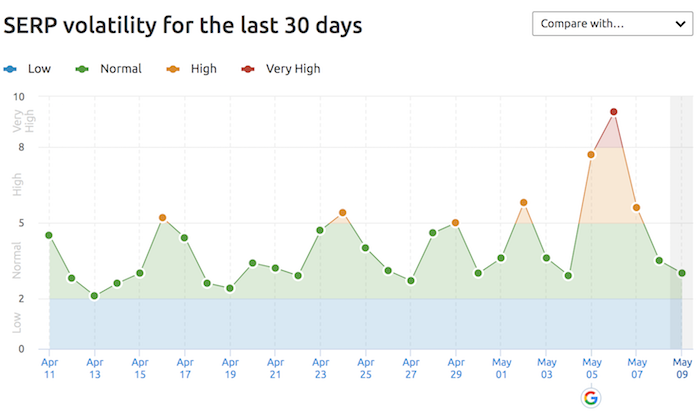
    Games to play with kids

    Parents are used to this over the summer, but not when it’s sprung on them for an indefinite period of time. How can your brand give them ideas and tools to entertain their kids while they’re home?

    Also trending: “family conversation starters”.

    Conclusion

    To round out this study, I want to show the results for “uplifting stories.”

    If you’re not responsible for delivering breaking news or important COVID-19 updates, look for opportunities to amplify joy, gratitude, hope, or any other positive emotion. People are looking for health and safety updates, but they’re looking for inspiration, too.

    Consider how any of these topics might apply to your brand, do some further exploring in the Moz Keyword Explorer, and focus on creating a content plan you feel confident in.


    Sign up for The Moz Top 10, a semimonthly mailer updating you on the top ten hottest pieces of SEO news, tips, and rad links uncovered by the Moz team. Think of it as your exclusive digest of stuff you don't have time to hunt down but want to read!


    * This article was originally published here