Wednesday, 4 March 2020

1,083,219 People Per Month and Counting: My New Favorite SEO Strategy

Podcasting.

You’ve heard about it before and I bet you’ve even listened to a handful of podcasts. But you probably haven’t created one yet.

Just think of it this way…

There are over 1 billion blogs and roughly 7 billion people in this world. That’s 1 blog for every 7 people…

On the other hand, there are roughly 700,000 podcasts. That means there is only 1 podcast for every 10,000 people or so.

Podcasting is 1,428 times less competitive than blogging.

So, should you waste your time on podcasting?

Well, let me ask you this… do you want a new way to get more organic traffic from Google?

I’m guessing you said yes. But before I teach you how to do that, let me first break down some podcasting stats for you, in case you aren’t convinced yet.

Is podcasting even worth it?

From a marketing and monetization standpoint, podcasting isn’t too bad.

I have a podcast called Marketing School that I do with my buddy Eric Siu. We haven’t done much to market it and over time it’s grown naturally.

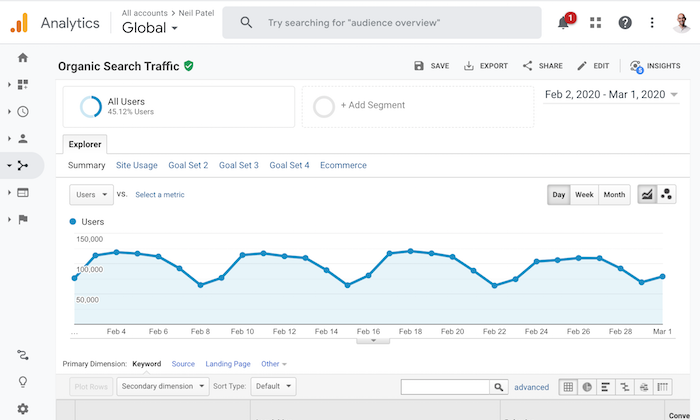
Here are the stats for the last month.

We got 1,083,219 downloads or “listens” last month. To give you an idea of what that is worth, Dream Host paid us $60,000 for an ad spot…

They’ve also been paying us for a while, technically we have a 1-year contract worth $720,000.

Now on top of the ad money, Eric and I both have gotten clients from our podcast. It’s tough to say how much revenue we’ve made from the podcast outside of advertising, but it is easy to say somewhere in the 7-figure range.

Keep in mind, when I make money through ads or generate revenue for my ad agency, there are costs so by no means does that revenue mean profit.

Sadly, my expenses are really high, but I’ll save that for a different post.

But here is the cool thing: Eric and I only spend 3 hours a month to record podcast episodes for the entire month. So, the financial return for how much time we are spending is high.

And if that doesn’t convince you that you need to get into podcasting, here are some other stats that may:

  • 32% of Americans listen to a podcast at least once a month.
  • 54% of listeners think about buying products advertised in podcasts.
  • Businesses spent $497 million on podcast ads in 2018 (probably much larger now).
  • 51% of monthly active podcast listeners have an annual household income of at least $75,000.

If you haven’t created a podcast, this guide will teach you how. And this one will teach you how to get your first 10,000 downloads.

Alright, and now for the interesting part…

How to get more SEO traffic through podcasting

Back in 2019, Google saw how podcasts were growing at a rapid pace and they didn’t want to miss out.

They wanted people to continually use Google, even when it came to learning information that is given over audio format. So they decided to make a change to their search engine and algorithm and started to index podcasts and rank them.
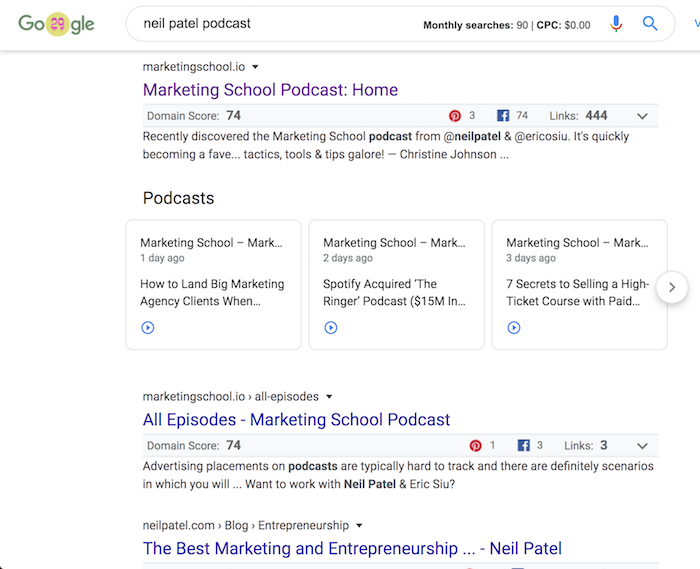
And depending on what you search for and the more specific you get, you’ll even notice that Google is pulling out details from specific episodes. This clearly shows that they are able to transcribe the audio automatically.

This shouldn’t be too much of a shocker as they’ve already had this technology for years. They use it on YouTube to figure out what a video is really about.

But here is the thing, just recording a podcast and putting it out there isn’t going to get you a ton of search traffic.

So how do you get more SEO traffic to your podcast?

It starts with topics

Podcasting is a lot like blogging.

If you create a blog post on any random topic that no one cares to read about, then you aren’t going to generate much traffic… whether it is from social or search.

The same goes for podcasting. If you have an episode on a random topic that no one cares to listen to, then you won’t get many downloads (or listens) and very little SEO traffic as well.

Just look at the stats for a few of our episodes.

Look at the screenshot above, you’ll see some do better than others.

For example, the episode on “7 Secrets to Selling High Ticket Items” didn’t do as well as “The 7 Best Marketing Conferences 2020” or even “How to Drive More Paid Signups In Your Funnel.”

You won’t always be able to produce a hit for every podcast you release, but there is a simple strategy you can use to increase your success rate.

First, go to Ubersuggest and type in a keyword or phrase related to what your podcast is about.
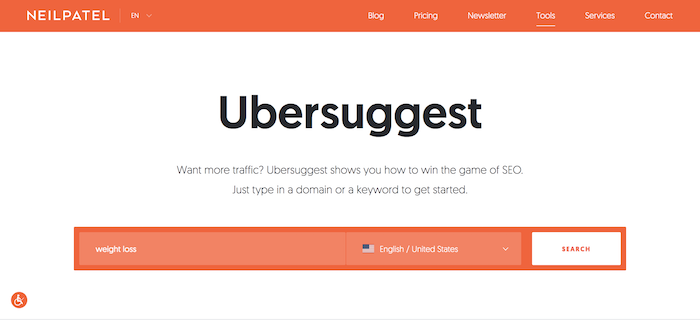
Once you type in your keyword or phrase, hit search.

You’ll land on a screen that looks something like this:
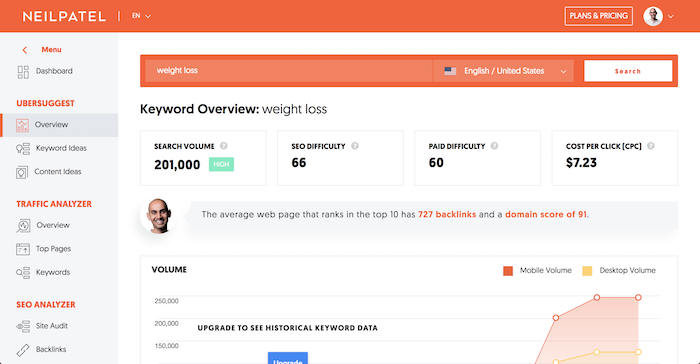
Then in the left-hand navigation, click on the “Content Ideas” option.
From there, you’ll see a list of popular topics on the subject you are researching.

This report breaks down popular blog posts based on social shares, SEO traffic, and backlinks.

Typically, if a blog post has all 3, that means people like the topic. Even if it has only 2 out of the 3, it shows that people are interested in the topic.

What we’ve found is that if a topic has done well as a blog post, it usually does well as a podcast episode.

See with the web, there are so many blogs, most topics have been beaten to death. But with podcasting, it is the opposite. Because there are very few podcasts, most topics haven’t been covered.

And if you take those beaten-to-death blog topics and turn them into podcast episodes, it is considered new, fresh content that people want to hear. And they tend to do really well.

Now you have to dive into keywords

Hopefully, you are still on the content ideas report and you’ve found some ideas to go after.

If not, just scroll down to the bottom of the Content Ideas report and keep clicking next… even if only a few numbers show, don’t worry, there are millions of results and as you go to the next page, more pages will show up.

Once you find a topic, I want you to click the “Keywords” button under the “Estimated Visits” column.
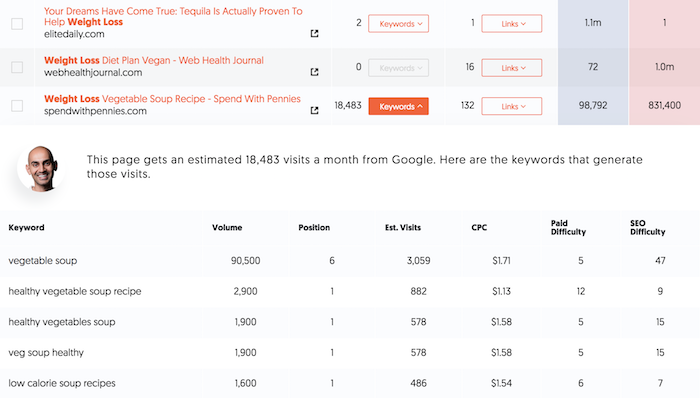
This will give you more specific keywords to mention and so you can go even more in-depth during your podcast episode.

Remember that Google is able to decipher your audio and knows what topics and keywords you are covering.

So, when you mention a keyword within your podcast, your podcast episode is more likely to rank for that keyword or phrase.

But there are a few things I’ve learned through this whole process:

  1. You don’t have to keyword stuff – you don’t have to mention a keyword 100 times or anything crazy if you want to rank well organically. Mention it whenever it is natural.
  2. Episodes titles that contain popular keywords tend to do better – do your keyword research and include the right keywords within your title (I’ll show you how in a bit).
  3. Episode titles that contain questions do well – eventually, you’ll also see these episodes perform even better because when people ask questions in the future on smart assistants like Alexa and Google Home, you’ll eventually start to see them pull from podcasts.

So how do you find the right keywords and questions to incorporate into your podcasts?

Head back to Ubersuggest and type in a keyword or phrase related to a podcast episode you want to create. This should be a bit easier now because you’ve already leveraged the Content Ideas report to come up with popular topics that people want to hear about. 😉

This time, I want you to click on the “Keyword Ideas” report in the left-hand navigation.
You’ll then see a list of suggestions that look something like this.
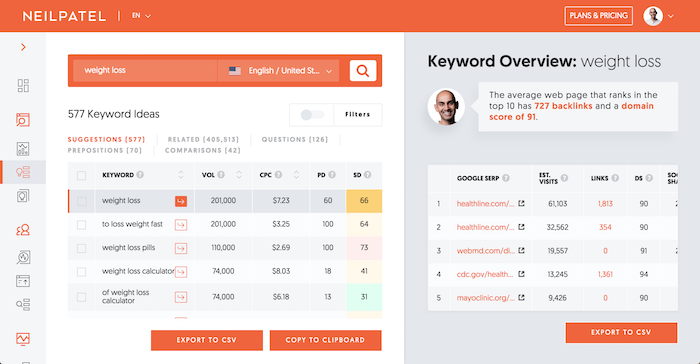
As you scroll down, you’ll continually see more and more keywords.

Don’t worry about the CPC data, but you will want to look at the SEO difficulty score as the easier the score the better chances you will have of ranking your podcast episode on Google. Also, look at search volume… the higher the number the better as that means more potential listens.

My recommendation for you is to target keywords and phrases that have an SEO difficulty of 40 or less.

Once you have a list of keywords, I want you to click on the “Related” navigational link on that report.
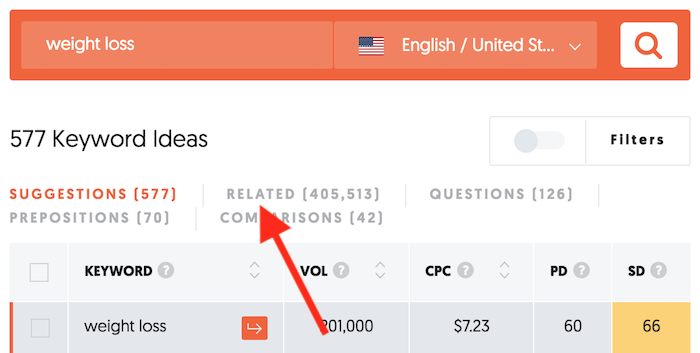
Now, you’ll see a much bigger keyword list.
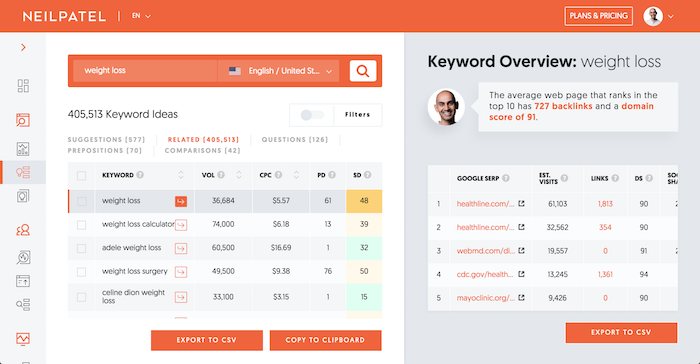
In this case, you’ll see 405,513 related keywords that you can target. Again, ignore the CPC data but target keywords with an SEO difficulty of 40 or less and the more popular the keyword the better.

Lastly, I want you to click on the “Questions” navigational link…
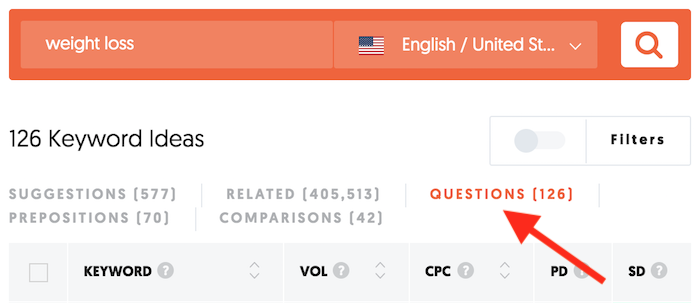
Then scroll through the list and you’ll see a list of questions that you can target.

According to Comscore, over 50% of the searches are voice searches. A large portion of those are questions, so covering them within your podcast or even labeling your titles based on questions is a great way to get more traffic.

If you don’t think going after questions is a good strategy to get more traffic, just look at Quora.
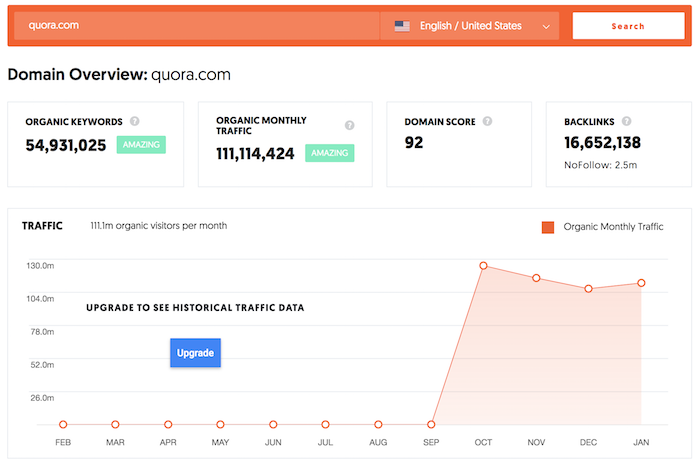
With roughly 111,114,424 estimated visits a month from Google, Quora is getting a lot of traffic by optimizing their site for question-related keywords.

Conclusion

Google is the most popular site in the world. Whether you love SEO or hate it, you have no choice but to leverage it.

One way to get more SEO traffic is to write tons of content and leverage content marketing. It’s a competitive approach and you should consider it.

But another solution that’s even easier is to create a podcast and rank it well on Google.

And ideally, you should be doing both.

Do you have a podcast? Have you tried ranking audio content on Google?

The post 1,083,219 People Per Month and Counting: My New Favorite SEO Strategy appeared first on Neil Patel.


* This article was originally published here

Tuesday, 3 March 2020

Heart, Ear, Eye, Mind, Mouth: Local SEO Exercises for Your Least Technical Clients

Posted by MiriamEllis

When was the last time you relaxed with a client?

As a local business consultant, I know that deeper marketing insights can be discovered when you set aside formality and share experiences: a moment, a laugh, a common bond. 

When I’m looking for ways to make life easier for a client, I sometimes reflect on ancient practices like yoga, tai chi, and mindful breathing, which are increasingly understood as beneficial to human health. For a space in time, they reduce the complex world we live in to a simpler one where being, breath, movement, and focus bring the practitioner to a more intuitive state. 

Local marketing agencies can empathize with the complex world their clients inhabit. Local business owners must manage everything from rent and employee benefits to customer service, business reviews, web content, and online listings. When you take on a new client, you expect them to onboard a ton of information about marketing their brand online. Sometimes, the most basic motivations go unaddressed and get lost in assumptions and jargon — instead of decreasing client stress for your least technical clients, you can accidentally increase it. 

Today, I’ll help you newly create an intuitive space by sharing five simple meditation exercises you can use with your agency’s clients. Instead of signaling via SEO, CTR, USPs, and GMB, let’s relax with clients by relating successful local search marketing practices to experiences people at any level of technical proficiency already understand.

Heart

To show their heart is in the right place, the Vermont Country Store publishes a customer bill of rights.

For a local business owner, there is no more important quality than having their heart in the right place when it comes to their motivation for running a company.

Yes, all of us work to earn money, but it’s the dedication to serving others that is felt by customers in every interaction with them. When customers feel that a business is there for them, it establishes the loyalty and reputation that secure local search marketing success. 

Heart meditation

Close your eyes for a few seconds and think of a time in your life when you most needed help from a business. Maybe you needed a tow truck, a veterinarian, a dentist, or a plumber. You really needed them to understand your plight, deliver the right help, and treat you as an important person who is worthy of respect. Whether you received what you required or not, remember the feeling of need. 

Now, extend that recognition beyond your own heart to the heart of every customer who feels a need for something your client can offer them.

A business owner with their heart in the right place can powerfully contribute to local search marketing by:

  • Running a customer-centric business.
  • Creating customer guarantees that are fair.
  • Creating an employee culture of respect and empowerment that extends to customers.
  • Creating a location that is clean, functional, and pleasant for all.
  • Honestly representing their products, services, location, and reputation.
  • Refraining from practices that negatively impact their customers and reputation.
  • Participating positively in the life of the community they serve.

A good local search marketing agency will help the business owner translate these basics into online content that meets customer needs, local business listings that accurately and richly represent the business, and genuine reviews that serve as a healthy and vital ongoing conversation between the brand and its customers. A trustworthy agency will ensure avoidance of any tactics that pollute the Internet with spam listings, spam reviews, negative attacks on competitors, and negative impacts on the service community. An excellent agency will also assist in finding and promoting community engagement opportunities, helping to win desirable online publicity from offline efforts.

Ear

Keter Salon of Berkeley, Calif. really listens to customers and it shows in its reviews.

Local business success is so linked to the art of listening, I sometimes think Google should replace their teardrop map markers with little ears. In the local SEO world, there are few things sadder than seeing local business profiles filled with disregarded reviews, questions, and negative photos. (Someone cue “The Sound of Silence”.)

From a business perspective, the sound of branded silence is also the sound of customers and profits trickling away. Why does it work this way? Because only 4% of your unhappy customers may actually make the effort to speak up, and if a business owner is not even hearing them, they’ve lost the ability to hear consumer demand. Let’s make sure this doesn’t happen.

Ear meditation

Close your eyes for a few seconds and listen closely to every noise within the range of your hearing. Ask yourself, “Where am I?”

The sound of typing, phone calls, and co-workers chatting might place you in an office. Sliding doors, footsteps on linoleum, and floor staff speaking might mean you’re at your client's brick-and-mortar location. Maybe it’s birdsong outside and the baby in their crib that tell you you’re working from home today. Listen to every sound that tells you exactly where you are right now.

Now, commit to listening with this level of attention and intention to the signals of customer voices, telling you exactly where a local brand is right now in terms of faults and successes. 

A business owner who keeps their ears open can actively gauge how their business is really doing with its customers by:

  • Having one-on-one conversations with customers.
  • Recording and analyzing phone conversations with customers.
  • Reading reviews on platforms like Google My Business, Yelp, Facebook and sites that are specific to their industry (like Avvo for lawyers or Healthgrades for physicians).
  • Reading the Q&A questions of customers on their Google Business Profile.
  • Reading mentions of their brand on social media platforms like Twitter, Facebook, and Instagram.
  • Reading the responses to surveys they conduct.
  • Reading the emails and form submissions the company receives.

A good local search marketing agency will help their client amass, organize, and analyze all of this sentiment to discover the current reputation of the business. From this information, you and your client can chart a course for improvement. Consider that, in this study, a 1.5 star improvement in online reputation increased consumer activity by 10%-12% and generated 13,000 more leads for the brands included. The first step to a better reputation is simply listening. 

Eye

Moz’s Local Market Analytics (Beta) helps you see your market through customer location emulation.

When your clients choose their business locations, they weigh several factors. They compare how the mantra of “location, location, location” matches their budget, and whether a certain part of town is lacking something their business could provide. They also look at the local competitors to see if the competition would be hard to beat, or if they could do the job better. Success lies in truly seeing the lay of the land.

Local search mirrors the real world. The market on the Internet is made up of the physical locations of your clients’ customers at the time they search for what your client has to offer. 

Eye meditation

You already know most of the businesses on your street, and many of them in your neighborhood. Now, with eyes wide open, start searching Google for the things your listening work has told you customers need. Where appropriate, include attributes you’ve noticed them using like “best tacos near me”, “cheapest gym in North Beach”, or “shipping store downtown.”

See how your client is ranking when a person does these type of searches while at their location. Now, walk or drive a few blocks away and try again. Go to the city perimeter and try again. Where are they ranking, and who is outranking them as you move about their geographic market?

A local business keeping its eyes open never makes assumptions about who its true competitors are or how its customers search. Instead, it:

  • Regularly assesses the competition in its market, taking into account the distance from which customers are likely to come for goods and services.
  • Regularly reviews materials assembled in the listening phase to see how customers word their requests and sentiments.
  • Makes use of tools to analyze both markets and keyword searches.

A good local search marketing agency will help with the tools needed for market and search language analysis. These findings can inform everything from what a client names their business, to how they categorize it on their Google My Business listing, to what they write about to draw in customers from all geographic points in their market. Clear vision simultaneously enables you to analyze competitors who are outranking your client and assess why they’re doing so. It can empower your client to report spammers who are outranking them via forbidden tactics. An excellent agency will help their client see their competitive landscape with eyes on the prize.

Mind

When an independent Arizona appliance chain surprised three shoppers with $10,000, it made headlines.


With hearts ready for service, ears set on listening, and eyes determined to see, you and your client have now taken in useful information about their brand and the customers who make up their local market. You know now whether they’re doing a poor, moderate, or exceptional job of fulfilling needs, and are working with them to strategize next steps. But what are those next steps? 

Mind meditation

Sit back comfortably and think of a time a business completely surprised you, or a time when an owner or employee did something so unexpectedly great, it convinced you that you were in good hands. Maybe they comped your meal when it wasn’t prepared properly, or special-ordered an item just for you, or showed you how to do something you’d never thought of before.

Recall that lightbulb moment of delight. Ask yourself how your client’s brand could surprise customers in memorable ways they would love. Create a list of those ideas.

A creative local business gives full play to the awesome imaginative powers of the brain. It gives all staff permission to daydream and brainstorm questions like:

  • What is something unexpected the business could do that would come as a delightful surprise to customers?
  • What is the most impactful thing the business could do that would be felt as a positive force in the lives of its customers?
  • What risks can the business take for the sake of benevolence, social good, beauty, renown, or joy?

A good local search marketing agency will help sort through ideas that could truly differentiate their clients from the competition and bring them closer to making the kinds of impressions that turn local brands into household names. An excellent agency will bring ideas of their own. Study “surprise and delight marketing” as it’s done on the large, corporate scale, and get it going at a local level like this small coffee roaster in Alexandria, Va. selling ethical java while doubling as funding for LGBTQ+ organizations. 

Mouth

Put your best stories everywhere, like in this social media example. Moz Local can help with publishing those stories.


“Think before you speak” is an old adage that serves well as a marketing guideline. Another way we might say it is “research before you publish”. With heart, ear, eye, and mind, you and your client have committed, collected, analyzed, and ideated their brand to a point where it’s ready to address the public from a firm foundation.

Mouth meditation

Open your favorite word processor on your computer and type a few bars of the lyrics to your favorite song. Next, type the first three brand slogans that come to your mind. Next, type a memorable line from a movie or book. Finally, type out the the words of the nicest compliment or best advice someone ever gave you. 

Sit back and look at your screen. Look at how those words have stuck in your mind — you remember them all! The people who wrote and spoke those words have indelibly direct-messaged you. 

How will you message the public in a way that’s unforgettable?

A well-spoken local business masters the art of face-to-face customer conversation. In-store signage and offline media require great words, too, but local search marketing will take spoken skills onto the web, where they'll be communicated via:

  • Every page of the website 
  • Every article or blog post 
  • Social media content
  • Review responses
  • Answers to questions like Google Business Profile Q&A
  • Business descriptions on local business listings
  • Google posts
  • Featured snippet content
  • Live chat
  • Email
  • Press releases
  • Interviews
  • Images on the website, business listings, and third-party platforms like Google Images and Pinterest
  • Videos on the website, YouTube, and other platforms

A good local search marketing agency will help their client find the best words, images, and videos based on all the research done together. An excellent agency will help a local business move beyond simply being discovered online to being remembered as a household name each time customer needs arise. An agency should help their clients earn links, unstructured citations, and other forms of publicity from those research efforts.

Determine to help your client be the "snap, crackle, pop", "un-Cola", "last honest pizza" with everything you publish for their local market, and to build an Internet presence that speaks well of their business 24-hours a day.

Closing pose


One of the most encouraging aspects of running and marketing a local business is that it’s based on things you already have some life experience doing: caring, listening, observing, imagining, and communicating. 

I personally should be better at technical tasks like diagnosing errors in Schema, configuring Google Search Console for local purposes, or troubleshooting bulk GMB uploads. I can work at improving in those areas, but I can also work at growing my heart, ear, eye, mind, and mouth to master serving clients and customers.

Business is technical. Business is transactional. But good business is also deeply human, with real rewards for well-rounded growth.


Sign up for The Moz Top 10, a semimonthly mailer updating you on the top ten hottest pieces of SEO news, tips, and rad links uncovered by the Moz team. Think of it as your exclusive digest of stuff you don't have time to hunt down but want to read!


* This article was originally published here

Monday, 2 March 2020

2020 Google Search Survey: How Much Do Users Trust Their Search Results?

Posted by LilyRayNYC

While Google’s mission has always been to surface high-quality content, over the past few years the company has worked especially hard to ensure that its search results are also consistently accurate, credible, and trustworthy.

Reducing false and misleading information has been a top priority for Google since concerns over misinformation surfaced during the 2016 US presidential election. The search giant is investing huge sums of money and brain power into organizing the ever-increasing amounts of content on the web in a way that prioritizes accuracy and credibility.

In a 30-page whitepaper published last year, Google delineates specifically how it fights against bad actors and misinformation across Google Search, News, Youtube, Ads, and other Google products.

In this whitepaper, Google explains how Knowledge Panels — a common organic search feature — are part of its initiative to show “context and diversity of perspectives to form their own views.” With Knowledge Panel results, Google provides answers to queries with content displayed directly in its organic search results (often without including a link to a corresponding organic result), potentially eliminating the need for users to click through to a website to find an answer to their query. While this feature benefits users by answering their questions even more quickly, it brings with it the danger of providing quick answers that might be misleading or incorrect.

Another feature with this issue is Featured Snippets, where Google pulls website content directly into the search results. Google maintains specific policies for Featured Snippets, prohibiting the display of content that is sexually explicit, hateful, violent, dangerous, or in violation of expert consensus on civic, medical, scientific, or historical topics. However, this doesn’t mean the content included in Featured Snippets is always entirely accurate.

According to data pulled by Dr. Pete Meyers, based on a sample set of 10,000 keywords, Google has increased the frequency with which it displays Featured Snippets as part of the search results. In the beginning of 2018, Google displayed Featured Snippets in approximately 12% of search results; in early 2020, that number hovers around 16%.

Google has also rolled out several core algorithm updates in the past two years, with the stated goal of “delivering on [their] mission to present relevant and authoritative content to searchers.” What makes these recent algorithm updates particularly interesting is how much E-A-T (expertise, authoritativeness, and trustworthiness) appears to be playing a role in website performance, particularly for YMYL (your money, your life) websites.

As a result of Google’s dedication to combating misinformation and fake news, we could reasonably expect searchers to agree that Google has improved in its ability to surface credible and trusted content. But does the average searcher actually feel that way? At Path Interactive, we conducted a survey to find out how users feel about the information they encounter in Google’s organic results.

About our survey respondents and methodology

Out of 1,100 respondents, 70% of live in the United States, 21% in India, and 5% in Europe. 63% of respondents are between the ages of 18 and 35, and 17% are over the age of 46. All respondent data is self-reported.

For all questions involving specific search results or types of SERP features, respondents were provided with screenshots of those features. For questions related to levels of trustworthiness or the extent to which the respondent agreed with the statement, respondents were presented with answers on a scale of 1-5.

Our findings

Trustworthiness in the medical, political, financial, and legal categories

Given how much fluctuation we’ve seen in the YMYL category of Google with recent algorithm updates, we thought it would be interesting to ask respondents how much they trust the medical, political, financial, and legal information they find on Google.

We started by asking respondents about the extent to which they have made important financial, legal, or medical decisions based on information they found in organic search. The majority (51%) of respondents indicated that they “very frequently” or “often” make important life decisions based on Google information, while 39% make important legal decisions, and 46% make important medical decisions. Only 10-13% of respondents indicated that they never make these types of important life decisions based on the information they’ve found on Google.

Medical searches

As it relates to medical searches, 72% of users agree or strongly agree that Google has improved at showing accurate medical results over time.

Breaking down these responses by age, a few interesting patterns emerge:

  • The youngest searchers (ages 18-25) are 94% more likely than the oldest searchers (65+) to strongly believe that Google’s medical results have improved over time.
  • 75% of the youngest searchers (ages 18-25) agree or strongly agree that Google has improved in showing accurate medical searches over time, whereas only 54% of the oldest searchers (65+) feel the same way.
  • Searchers ages 46-64 are the most likely to disagree that Google’s medical results are improving over time.

Next, we wanted to know if Google’s emphasis on surfacing medical content from trusted medical publications — such as WebMD and the Mayo Clinic — is resonating with its users. One outcome of recent core algorithm updates is that Google’s algorithms appear to be deprioritizing content that contradicts scientific and medical consensus (consistently described as a negative quality indicator throughout their Search Quality Guidelines).

The majority (66%) of respondents agree that it is very important to them that Google surfaces content from highly trusted medical websites. However, 14% indicated they would rather not see these results, and another 14% indicated they’d rather see more diverse results, such as content from natural medicine websites. These numbers suggest that more than a quarter of respondents may be unsatisfied with Google’s current health initiatives aimed at surfacing medical content from a set of acclaimed partners who support the scientific consensus.

We asked survey respondents about Symptom Cards, in which information related to medical symptoms or specific medical conditions is surfaced directly within the search results.

Examples of Symptom Cards. Source: https://blog.google/products/search/im-feeling-yucky-searching-for-symptoms/

Our question aimed to gather how much searchers felt the content within Symptom Cards can be trusted.

The vast majority (76%) of respondents indicated they trust or strongly trust the content within Symptom Cards.

When looking at the responses by age, younger searchers once again reveal that they are much more likely than older searchers to strongly trust the medical content found within Google. In fact, the youngest bracket of searchers (ages 18-25) are 138% more likely than the oldest searchers (65+) to strongly trust the medical content found in Symptom Cards.

News and political searches

The majority of respondents (61%) agree or strongly agree that Google has improved at showing high-quality, trustworthy news and political content over time. Only 13% disagree or strongly disagree with this statement.

Breaking the same question down by age reveals interesting trends:

  • The majority (67%) of the youngest searchers (ages 18-25) agree that the quality of Google’s news and political content has improved over time, whereas the majority (61%) of the oldest age group (65+) only somewhat agrees or disagrees.
  • The youngest searchers (ages 18-25) are 250% more likely than the oldest searchers to strongly agree that the quality of news and political content on Google is improving over time.

Misinformation

Given Google’s emphasis on combating misinformation in its search results, we also wanted to ask respondents about the extent to which they feel they still encounter dangerous or highly untrustworthy information on Google.

Interestingly, the vast majority of respondents (70%) feel that they have encountered misinformation on Google at least sometimes, although 29% indicate they rarely or never see misinformation in the results.

Segmenting the responses by age groups reveals a clear pattern that the older the searcher, the more likely they are to indicate that they have seen misinformation in Google’s search results. In fact, the oldest searchers (65+) are 138% more likely than the youngest searchers (18-25) to say they’ve encountered misinformation on Google either often or very frequently.

Throughout the responses to all questions related to YMYL topics such as health, politics, and news, a consistent pattern emerged that the youngest searchers appear to have more trust in the content Google displays for these queries, and that older searchers are more skeptical.

This aligns with our findings from a similar survey we conducted last year, which found that younger searchers were more likely to take much of the content displayed directly in the SERP at face value, whereas older searchers were more likely to browse deeper into the organic results to find answers to their queries.

This information is alarming, especially given another question we posed asking about the extent to which searchers believe the information they find on Google influences their political opinions and outlook on the world.

The question revealed some interesting trends related to the oldest searchers: according to the results, the oldest searchers (65+) are 450% more likely than the youngest searchers to strongly disagree that information they find on Google influences their worldview.

However, the oldest searchers are also most likely to agree with this statement; 11% of respondents ages 65+ strongly agree that Google information influences their worldview. On both ends of the spectrum, the oldest searchers appear to hold stronger opinions about the extent to which Google influences their political opinions and outlook than respondents from other age brackets.

Featured Snippets and the Knowledge Graph

We also wanted to understand the extent to which respondents found the content contained within Featured Snippets to be trustworthy, and to segment those responses by age brackets. As with the other scale-based questions, respondents were asked to indicate how much they trusted these features on a scale of 1-5 (Likert scale).

According to the results, the youngest searchers (ages 18-25) are 100% more likely than the oldest searchers (ages 65+) to find the content within Featured Snippets to be very trustworthy. This aligns with a similar discovery we found in our survey from last year: “The youngest searchers (13–18) are 220 percent more likely than the oldest searchers (70–100) to consider their question answered without clicking on the snippet (or any) result.”

For Knowledge Graph results, the results are less conclusive when segmented by age. 95% of respondents across all age groups find the Knowledge Panel results to be at least “trustworthy.”

Conclusion: Young users trust search results more than older users

In general, the majority of survey respondents appear to trust the information they find on Google — both in terms of the results themselves, as well as the content they find within SERP features such as the Knowledge Panel and Featured Snippets. However, there still appears to be a small subset of searchers who are dissatisfied with Google’s results. This subset consists of mostly older searchers who appear to be more skeptical about taking Google’s information at face value, especially for YMYL queries.

Across almost all survey questions, there is a clear pattern that the youngest searchers tend to trust the information they find on Google more so than the older respondents. This aligns with a similar survey we conducted last year, which indicated that younger searchers were more likely to accept the content in Featured Snippets and Knowledge Panels without needing to click on additional results on Google.

It is unclear whether younger searchers trust information from Google more because the information itself has improved, or because they are generally more trusting of information they find online. These results may also be due to older searchers not having grown up with the ability to rely on internet search engines to answer their questions. Either way, the results raise an interesting question about the future of information online: will searchers become less skeptical of online information over time?


Sign up for The Moz Top 10, a semimonthly mailer updating you on the top ten hottest pieces of SEO news, tips, and rad links uncovered by the Moz team. Think of it as your exclusive digest of stuff you don't have time to hunt down but want to read!


* This article was originally published here